 MANACAPURU, BRAZIL – Municipal officials were staggered today to learn that a huge hot and arid desert has been discovered within a fifty-minute helicopter ride from the city of Manacapuru. The desert, as yet officially unnamed, is larger than the Arabian Desert and second only in size only to the Sahara and the polar deserts. It covers almost one million square miles.
The area where it was found lies northwest of Manacapuru. It bisects the Rio Negro River and is located on a direct flight path in and out of Eduardo Gomes International Airport (MAO). It was discovered by a group of high school students from who were on a nature hike in the rainforest.
“We were shocked to find out about it, as it’s not on any of our maps” said Hugo Silva, a municipal official from Anamã. “But we see it as a good thing because when the word gets out, it should definitely bring more tourists to the area.”
Cartographers around the world are scrambling to determine how and why a desert with an area larger than Mexico could exist undiscovered for so long in the days of satellites and Google Maps.
Matheus Henrique Sousa, a scientist who works for the Bureau of Cartography and GIScience in Rio de Janeiro, and is an expert on the tropical rainforest effect, provided an explanation for the oversight. “It’s a strange one, I’ll admit,” he said. “But the answer is quite simple. It’s the sheer density of the arboreal canopy in that region. No one can possibly see through it from the air, not even Google Maps.”
Guilherme Oliveira, who heads up the Manacapuru department of tourism agreed with Hugo Silva, his municipal counterpart from Anamã. “Absolutely surprising. I mean, who knew, right? We’re been known as a rainforest kind of place for years. But if you get lemons, you make lemonade. And you can sell a lot of that in a desert.” Source: FNT Staff
Photo credit: Original images at Wikipedia and WorldAtlas
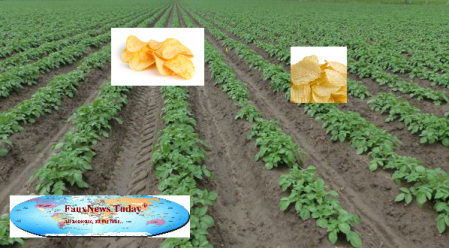 GUELPH, ONTARIO – Two first-year research students in horticultural science at the University of Guelph have successfully completed an experimental small-plot olericulture study in growing a potato chip cultivar. The students were able to produce two different varieties of potato chips, plain and ripple.
 FauxNews Today ®