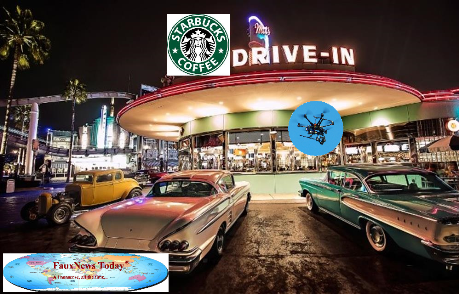
 OTTAWA – In a move that the company is calling ‘futuristic-retro” the Starbucks Corporation has announced that it will open fifteen-hundred drive-in coffee shops using airborne drones as carhop servers, in selected cities across North America. Starbucks will pioneer the new model in six Canadian cities first, beginning next year.
“Listen, let’s face it, humans are becoming passé,” said Peter Wanhauser, a Starbucks spokesperson, when he was asked why the company would use drones to serve customers rather than employ people to do the job. “The future is technology, and the future is here now.”
Wanhauser also explained, excitedly and without a trace of irony, why Starbucks had paradoxically chosen to incorporate a sixty-five-year-old business model from the nineteen-fifties as part of their expansion plan for the future.
“Our focus group studies have shown that everybody today really, really, really loves the old stuff,” he said. “So we’re staying absolutely 100 percent true to the original concept. We’re just changing it to bring it in line with our own thinking.”
A leaked internal, executive-level corporate e-mail memo also shed light on why the company decided to launch the futuristic-retro initiative in Canada first.
The memo submitted that: “Canadians will basically line up in droves to buy in to any new trendy absurdity without question, embrace it wholeheartedly and tell all their friends about it. As cutting-edge, money-making ideas go, this one’s a slam dunk there.”
Wanhauser would not comment on the memo, but emphatically denied a rumour that Starbucks was planning on also using drones as baristas. Source: FNT Staff
Photo credit: Original images at: Starbucks, CSO Online and Frostop Root Beer
 HAMILTON – A team of two medical research professors and a graduate student from McMaster University has published a research paper that concludes that medical marijuana is a sure-fire cure for warts. The paper, however, is not without controversy.
 FauxNews Today ®